

What is mycelium composite?
Mycelium composite is a material consisting primarily of fungal mycelium combined with natural fibres such as straw, wood shavings, or other plant materials. During drying, it forms a stable structure that is both lightweight and robust.
Fungi are among the most promising raw materials for the construction industry: they grow rapidly on agricultural and forestry by-products, turning waste into value, need very little energy and water to do so, and leave behind materials that can return to the natural cycle at the end of their life.
Thermal insulation
At the heart of the development is Mycotherm, an insulation panel for interior construction. Raw materials include residues from Reishi mushroom cultivation and regional biomass from agriculture and forestry.


Mycotherm can be used for the interior insulation of walls, ceilings, and attics, in both new construction and renovation projects. The panels can be cut to size and processed like conventional insulation materials. At the end of their service life, they are fully compostable, and their CO₂ balance is negative.
For production, the biomass is moistened, mixed, and placed in moulds. The mycelium grows through the material and binds it into a solid panel without synthetic adhesives, which is then dried.

Depending on the composition of the components and the chosen production process, panels with different properties can be manufactured.

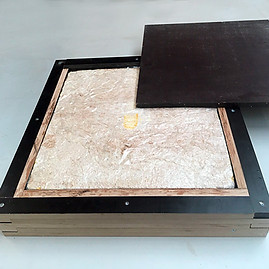
Thanks to the casting process, new designs and possibilities emerge. Unlike conventional methods, no offcuts are produced, and defective products can be reintroduced into the production process.
In further processing, the mycelium-based panels can be refined and combined with additional functions.
From an environmental perspective, fungal mycelium composite as a material offers many advantages: it binds CO₂, is recyclable and compostable, and free of pollutants. Furthermore, its production requires significantly less energy than conventional insulation boards. In addition to insulation boards, Mycostrat also tests and produces building panels and bricks made from fungal mycelium composite.


